
Regulations & Compliance · Updated 6 May 2026
UK Balustrade Regulations Explained.
Approved Document K, BS 6180:2011, the 100mm sphere rule, and 0.74kN line load — what they actually require, where most projects fail, and when to call a structural engineer.

Abbie Lee
reading time
7 min
category
Guides
share
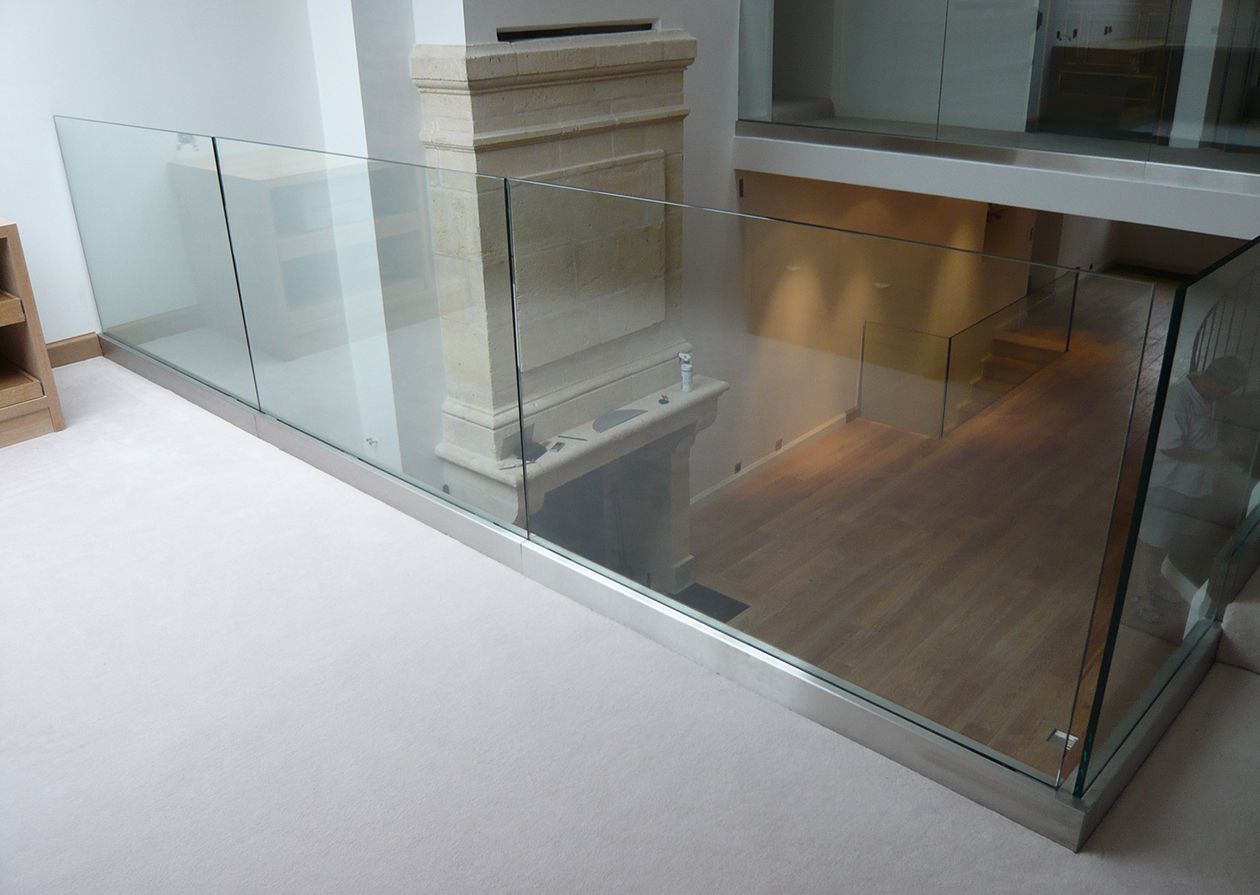
UK balustrade regulation is governed by two documents: Approved Document K (the building regulations Part K, covering protection from falling, collision and impact) and BS 6180:2011 (the British Standard for barriers in and about buildings). Together they specify how high a balustrade has to be, how strong, how it must perform under load, and what the openings between its members can be. This guide unpacks both, in plain English.
— 01 What the regulations cover
Approved Document K is the legal requirement under the Building Regulations 2010, specifically Schedule 1 Part K. It defines the minimum standards a balustrade must meet on a UK building — domestic, commercial, public — for it to be lawful. BS 6180:2011 is a British Standard, voluntary in legal terms, but referenced by Doc K and by structural engineers as the practical specification for designing barriers.
In practice you can’t comply with one without the other. Doc K tells you what’s needed; BS 6180 tells you how to engineer it.
— Quick reference
Doc K
Approved Document K (Part K of the Building Regulations 2010): protection from falling, collision and impact. Statutory.
BS 6180:2011
British Standard for barriers in and about buildings - code of practice. Voluntary but referenced by Doc K.
Pitch line
The line connecting the nosings of the treads on a stair flight. Balustrade height on stairs is measured from this line, not the tread itself.
Line load
A horizontal force applied to the top rail. Domestic balustrade must withstand 0.74kN/m; commercial balustrade up to 3.0kN/m.
— 02 Approved Document K — the four headline rules.
1. Guard-rail height
For domestic stairs, the guard-rail must be at least 900mm measured vertically above the pitch line of the stair. For balconies and landings, the guard-rail must be 1,100mm above the finished floor level. Higher minimums apply at first floor and above on commercial buildings.
Approved Document K · Paragraph 1.34
Pedestrian guarding for stairs in dwellings should have a height of at least 900mm measured vertically above the pitch line for stair flights.
— HM Government, Approved Document K (2013, with 2024 revisions)
2. The 100mm sphere rule
Where children under five could use the building (which Doc K interprets liberally — most domestic projects qualify), the balustrade must not allow a 100mm-diameter sphere to pass through any opening. This rule is the single most common reason new balustrade specs get rejected at building control.
Horizontal wire balustrade fails this test. Wire centres of 100mm or 110mm let a 100mm sphere pass between the wires. Specifying horizontal wire on a family staircase without modification means the design will be rejected.
— SWR Technical Team
The 100mm sphere rule is the reason most new staircase balustrades get rejected. It’s easy to design around, hard to design through.
Compliant alternatives:
- Vertical wire balustrade at 90mm centres — passes the rule
- Glass infill (modular or channel) — passes by default
- Horizontal wire with closely-spaced top/bottom rails preventing climbing — case-by-case
3. Hand support
A continuous handrail must be available on at least one side of any stair flight. A balustrade with a structural top rail satisfies this requirement; a wire balustrade without a top rail does not — a separate handrail is required, fixed either to the side wall or to the stringer.
4. Glass selection
Glass used in balustrade must be either toughened (Class 1A or 1B per BS EN 12600) or laminated. Frameless glass channel systems require a structural glass type with appropriate post-breakage retention — typically 13.5mm laminated toughened on residential, 17.5mm or 21.5mm on commercial.
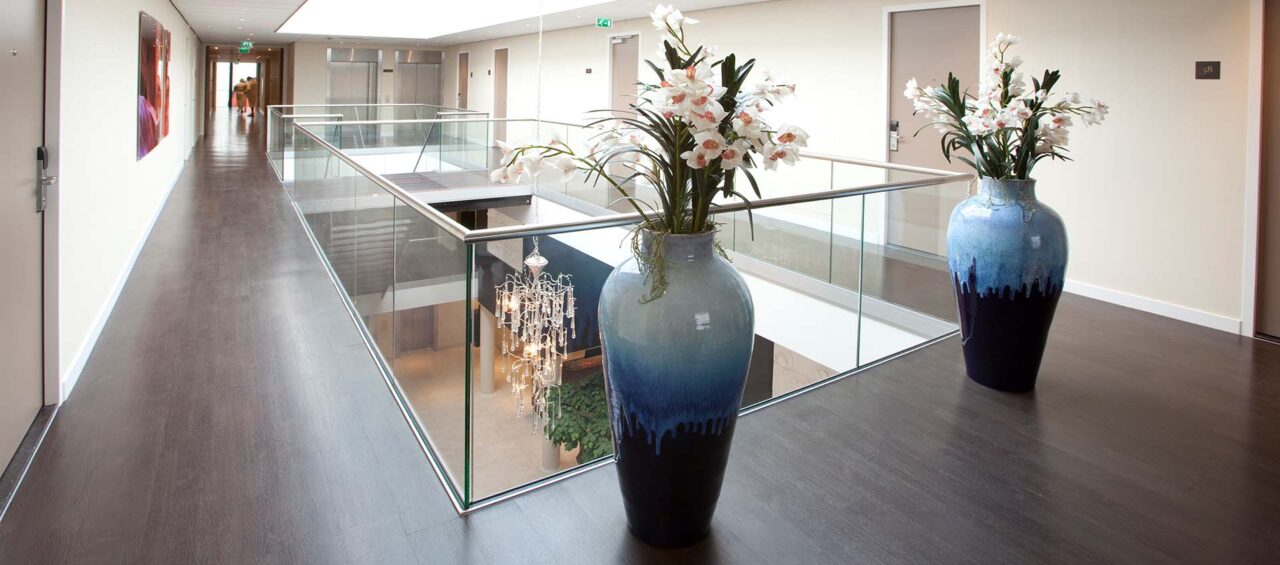
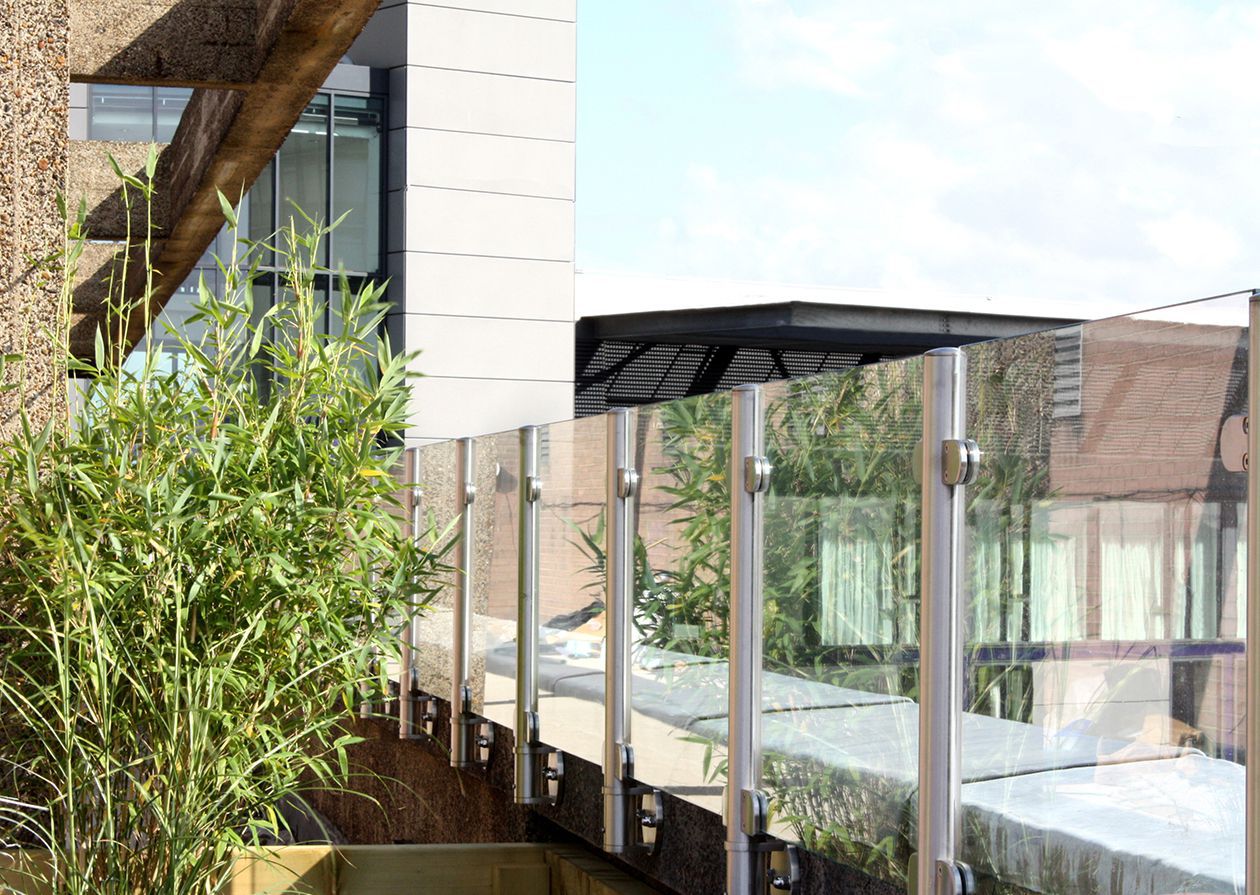
Fig 1 Glass selection is governed by opening size and post centres. A 1,200mm post-centre frameless glass channel run typically requires 13.5mm laminated toughened on residential applications.
— 03 BS 6180:2011 — the structural test.
BS 6180:2011 is the British Standard that tells you how strong a balustrade must be. It defines three load cases that every balustrade must withstand:
- Horizontal line load on the top rail. 0.74kN/m for domestic, 1.5kN/m for commercial assembly areas, 3.0kN/m for crowded grandstands.
- Horizontal distributed load on the infill. 1.5kN/m² applied to the area of the balustrade between the top and bottom rails.
- Point load. 1.5kN applied to any 100mm × 100mm area of the infill.
For wire balustrade and frameless glass channel, the line load is the determining figure — it sizes the post centres, the channel depth, and the glass thickness. Project-specific structural calculations must be produced before the balustrade can be installed lawfully.
BS 6180:2011 · Section 6.4.1
Barriers in single-occupancy dwellings shall withstand a horizontal line load of 0.74kN/m applied at the top of the barrier, plus a horizontal uniformly distributed load of 1.0kN/m² and a point load of 1.0kN over any area of 0.1m × 0.1m.
— BSI, BS 6180:2011 (Code of practice for barriers in and about buildings)
— 05 Common compliance failures.
Across the projects we’ve seen, the same five failures account for the overwhelming majority of building-control rejections:
- Horizontal wire on a staircase. The 100mm sphere rule defeats every standard horizontal wire spec. Compliant only with vertical wire or with restraining rails added.
- Insufficient guard-rail height on a balcony. 900mm is for stairs only — balconies need 1,100mm.
- Missing structural calcs on glass channel. Frameless glass requires project-specific structural sign-off. A spec sheet showing manufacturer test data is not the same thing as a wet-stamped calculation for your run length.
- Untoughened glass on balustrade. Float glass or annealed glass cannot be specified for any balustrade application — even back-painted decorative glass fails.
- Stair handrail missing on a wire balustrade run. Wire alone doesn’t satisfy the hand-support requirement. A side handrail or top-rail addition is mandatory on stairs.
— 04 Where residential and commercial regs differ.
The biggest jump in regulation severity is between residential and commercial. A balustrade that is fine for a private home will fail at a hotel, a public stair, or a school. The differences:
– Height: 900mm domestic stair / 1,100mm domestic balcony, vs 1,100mm commercial stair / 1,100mm commercial balcony with extra requirements at high-level
– Line load: 0.74kN/m domestic, vs 1.5–3.0kN/m commercial depending on building use class
– Glass spec: 13.5mm laminated typical domestic, vs 17.5mm or 21.5mm laminated typical commercial
– Post-breakage retention: Mandatory for frameless glass channel on commercial, recommended on residential
If the project is a holiday let, an Airbnb, or a landlord-let HMO, treat it as commercial. The lighter domestic spec will not satisfy a building control officer or a future insurance claim.
— 06 When to get specialist sign-off.
Most domestic supply-only orders ship with a manufacturer’s test certificate and a generic compliance statement. That’s enough for a building-control officer who wants to see the spec is sound. It’s not enough for the following:
- Frameless glass channel on any project — always project-specific calcs
- Curved or helical staircase balustrade — bespoke load distribution
- Commercial balcony or stair with an unusual run length (over 3m unsupported)
- Coastal or exposed marine projects — wind load calc
- Listed building or conservation area — separate consent process
- Any project where the line load exceeds 1.5kN/m
For these, SWR includes project-specific structural calculations as part of the quote — produced by an independent structural engineer, wet-stamped, valid as building-control evidence. There’s no extra cost for this; it’s part of how we supply the system.
— 07 Summary.
Doc K and BS 6180 are not optional and they’re not vague. They specify exact heights, exact loads, and exact opening sizes. The good news for anyone designing a balustrade is that compliance is mostly a matter of choosing the right system for the project — vertical wire or glass for child-safe applications, glass channel with calcs for high-end residential, modular for commercial. The wrong system on the wrong project will fail; the right system on the right project passes without drama.
If you’re not sure where your project lands, send us a sketch. We’ll tell you which compliance route applies, which system fits, and what calcs you’ll need at building control.

Abbie Lee
Related articles
Continue reading the Knowledge Hub.
Talk to a specialist
Compliance question on a real project? Send us a sketch.
A working drawing and a couple of photos is enough for us to tell you which Doc K and BS 6180 routes apply, which SWR system fits, and what evidence you’ll need at building control.